Blue in the Frame Thinking Maps Sentence Starters

Primary Composition Writing | Starting Sentences with Introductory Clauses

Hello! Welcome back to the blog! As your oral and SA1 examinations draw near, I hope you are not overwhelmed by school work and revision. To give you a helping hand, I have prepared a resource for you which can be downloaded at the end of the post. Look out for it!

Before that, let's focus on the topic for today. As you know, the beautiful thing about English is that the various components of the language overlap with one another and the skills learnt are often applicable across various components. For instance, since a sentence can be written or spoken, knowing a variety of sentence structures will be useful for both writing and speaking. That is exactly what I thought would be useful to revise with you today – the use of sentence starters to help you create variety in your sentence structures.

In our previous post, we have talked about how to apply sentence starters to enhance a paragraph consisting of sentences that tend to begin mainly with a noun or pronoun. Shall we revise again here? Take a look at the following paragraph:

Subject Verb Object

There are no grammatical errors in the sentences. However, the repetition of the SVO structure made the paragraph dull and monotonous. How then do we change things up and make the paragraph more interesting?

A good way to break up the monotony of the sentences is to use introductory clauses.

Sentence Starters Revision

Introductory clauses

Introductory clauses are dependent clauses made up of words that provide more information for the independent clauses. As its name suggests, it introduces a sentence and can be thought of as the "setting" of a main sentence. These clauses reveal information about when, where, how, why, or under what circumstances the action occurs.

Here is a list of the different types of introductory clauses. (This list is not exhaustive.)
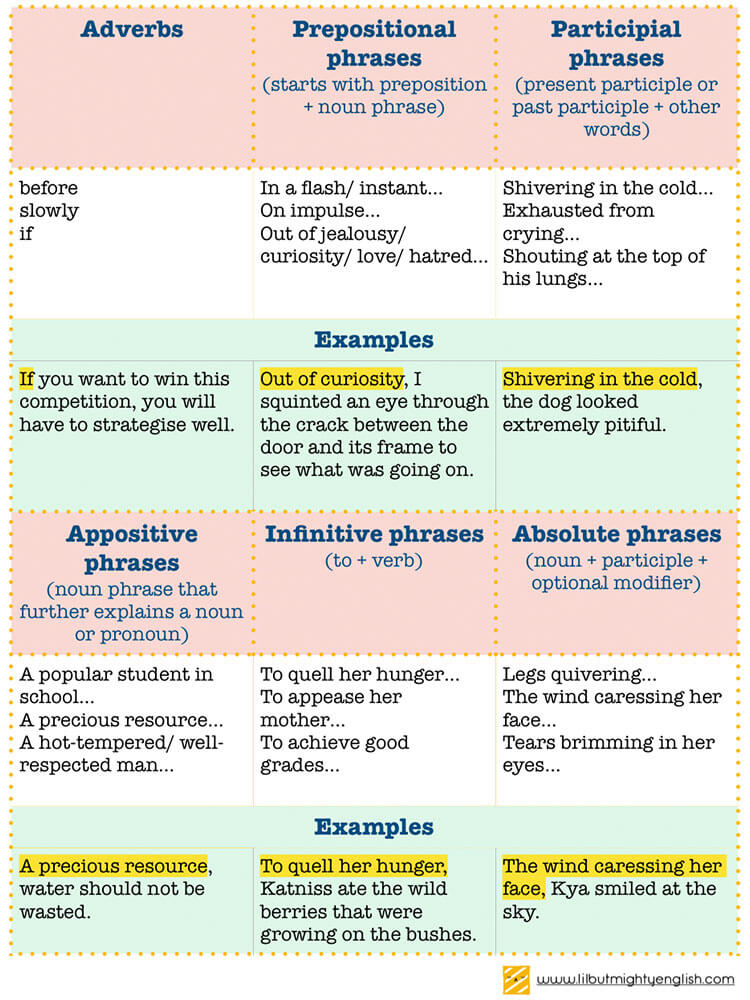
Adverbs, Prepositional Phrases, Participial Phrases

Remember to put your commas

Introductory clauses often require a comma. This provides an appropriate pause when reading and helps ensure that the intended meaning is conveyed.

Look at this example:

After eating Grandma went to bed. (Grandma was eaten? Confusion occurs!)

After eating, Grandma went to bed.  (Phew, no confusion here!)

Do note that there are exceptions to this. For example, the sentence "To go for an interview without any preparation would be foolish." does not require a comma.

Now let's try to improve on the sample paragraph earlier by using some of these introductory clauses!
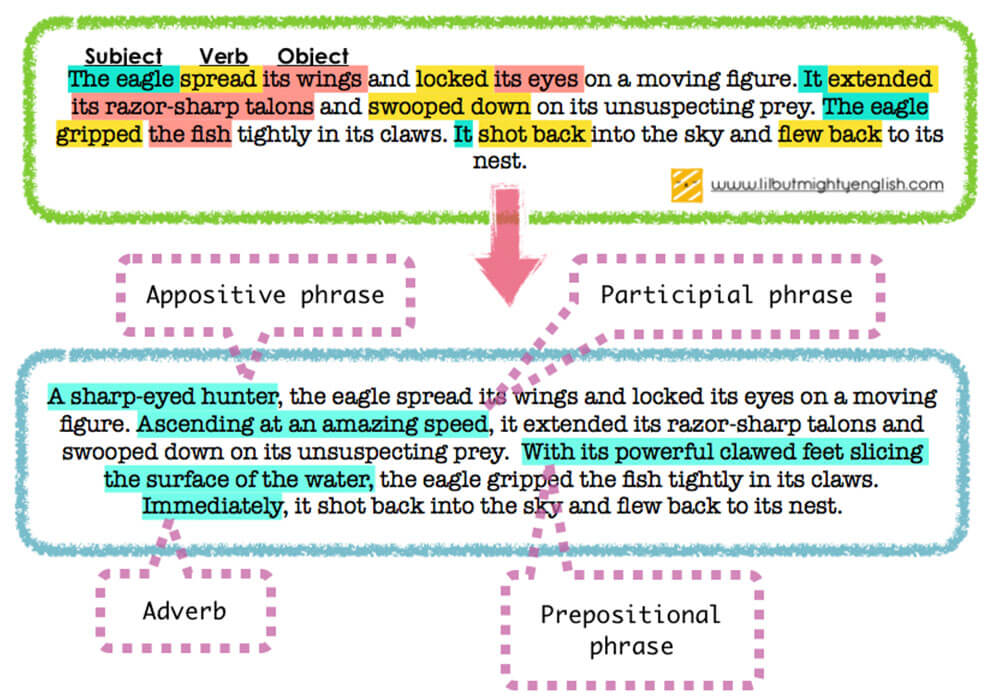
Subject Verb Object

I hope you are clearer about the various types of introductory clauses and how you can use them. To practise (Infinitive clause!), try adding the introductory clauses to the following sentences:
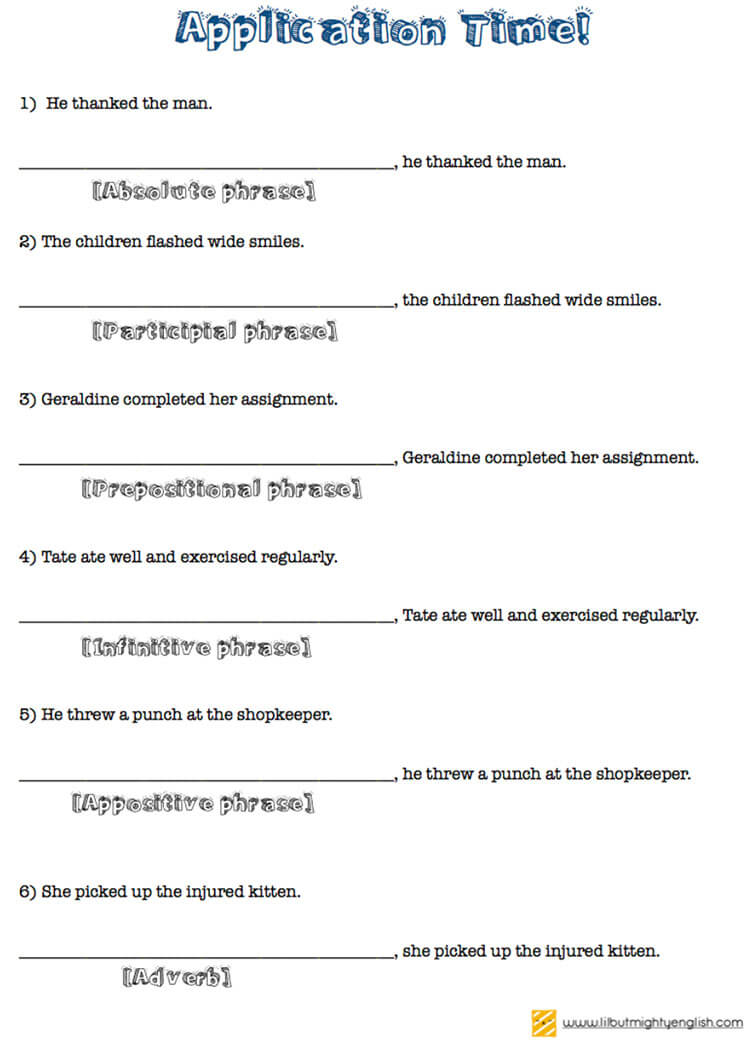
Application Time!

Wish to know the suggested answers to the above? If you would like a longer list of the clauses for revision as well as the suggested answers, the good news is that they are available to be downloaded here. All the best and impress your examiners by using these clauses to begin your sentences now!

FREE List of Sentence Starters

Sign up to receive your list of sentence starters and suggested answers!

Thank you!

Ms Cynthia

Ms Cynthia is an English Teacher at Lil' but Mighty. In her 5 years of English Language teaching experience, she has enjoyed guiding her students to explore the literary world and provide them with the tools to unpack and decipher texts. As a teacher who is passionate about the language, she hopes to inspire the children to become creative and critical thinkers who will be ready to face the challenges of the world.

Have something to share? Drop us a comment below!

Share

Other related posts

Bingo Revision 4 Ways

Bingo Revision 4 Ways!

In this post, I am going to show you how the modest game of Bingo can be used as a fun revision tool.

3 Common Grammar Misconceptions

4 ways to practise Oral

Newspaper: 4 Ways to Practise Oral

Teachers Who Love English, We Want You!
commonly confused pairs

5 Commonly Confused Pairs (or is it Pears?)

Steps to Score Well in Situational Writing for PSLE English

I Love Reading | 3 Tips for Reluctant Readers

The First Write Recipe Workshop at Greenridge Primary School!

20 Commonly Tested Phrasal Verbs

20 Commonly Tested Phrasal Verbs!

Understanding IF Conditionals!

3 Ways to Learn English from Phishing Emails

3 Ways to Learn English from Phishing Emails

Fans of Fiction: 3 Websites to Check Out This Holiday

free editing resource

NYT Copy-Edit This: Free Editing Resource

3 Writing Skills to Start Nurturing from Primary 2

5 Ways to Start a Primary School Composition

sharing oral stories

2 Common Errors to Avoid When Sharing Oral Stories

4 Lively Literary Devices to Use in Your Compositions

Comprehending Comprehension: 3 Pitfalls to Avoid When Understanding Questions

Fun Classroom Display Tools

4 Fun & Interactive Classroom Display Tools!

Reading | Video: A Totto-ly Delightful Read!

Insert Exciting Dialogue Tags to Your Primary School Composition!

To start off with, let me share with you the power of using dialogue. Dialogue is an essential part of the story.

How to Pronounce the /th/ Sound?

In this post, I would like to help you to start mastering the /th/ sound with 2 simple steps.

Perfecting the Paragraph: Know When To Start A New Paragraph

We all know that to write a good story, we need to have a clear structure. But how do we structure our stories? If your answer is, "by having paragraphs", then you are very nearly correct.

7 Essay Types at the O Level

7 Essay Types at the O Level

Five Essentials to Score for Formal Situational Writing

Let's Go On A Learning Journey | Two Awesome Places To Visit During the December Holidays!

Activities for the Holidays!

Between Two Commas: How to Deal with Extra Information

Continuous Writing: 3 Specific Things to Check For!

PSLE English Specialist Teacher Wanted!

Paper 2: Don't Lose the Marks Everyone is Getting!

Paper 2: Don't Lose the Marks Everyone is Getting!

5 Graphic Novels To Check Out This Holiday

Authentic Learning Activity | Editor on the Move!

Free News Sources for Kids

Holiday + Learning = Fun!

Primary 4 Marching Onto Primary 5: Changes You Need to Know for English

Continuous Writing | 4 Tips to Address the Topic

3 Composition Techniques

3 Composition Techniques You Can Reap From Reading

Conquering Correlative Conjunctions in Sentence Synthesis: 3 Commandments to Comply with

Composition Writing | 3 Ways to Write A Good Line of Dialogue

3 Ways to Build A Confident Child With Your Choice of Words!

Look Back in a Flash! 3 Ways to Craft Effective Flashbacks

Building Grammar Foundations: Start Young, Start Now

"E" is for Empathy | What Every Primary School Child Needs!

3 Tips On How To Prepare For Primary School Oral | Stimulus-Based Conversation

Primary School Vocabulary: Confuse, Confused, Confusing? Which is Which?

Introducing: Mighty Monsterella!

study smart

Study Smart! | 3 Revision Tips for Primary School Students!

Announcing the Winner of our 'Queen of Your Heart' Mother's Day Contest!

Accuracy in Situational Writing

Accuracy in Situational Writing: Check for These 3 Things!

Previous

Next

Like what you are reading?

Subscribe now to receive news and tips hot off the press!

Primary School English Tuition| Lil' but Mighty English

woodardfreyed.blogspot.com

Source: https://lilbutmightyenglish.com/blog/primary-composition-writing-starting-sentences-with-introductory-clauses

0 Response to "Blue in the Frame Thinking Maps Sentence Starters"

Post a Comment

Iklan Atas Artikel

Iklan Tengah Artikel 1

Iklan Tengah Artikel 2

Iklan Bawah Artikel