Do Members of Congress Have to Be Elected Again
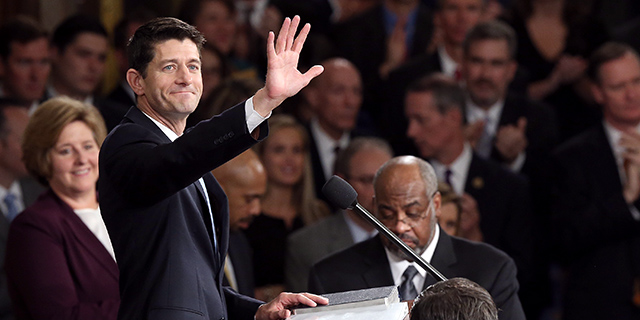
 Firm Speaker Paul Ryan's announcement Wednesday that he would not seek re-election adds a big name to what was already shaping up to be a near-record yr of seat turnovers in the U.S. House of Representatives. More House members are choosing not to run for re-election to that body than at any time in the by quarter-century – including a tape number of Republicans, according to a Pew Research Eye assay.
As of April 11, 55 representatives (38 Republicans and 17 Democrats) have appear they're not running for new terms, co-ordinate to our count. In addition, one Republican (Blake Farenthold of Texas) and one Democrat (John Conyers of Michigan) take resigned. That makes a full of 57 voluntary departures, or thirteen% of the House'south full voting membership.
Those counts could rise further, since the filing deadlines in several states haven't nonetheless passed. Still, the number of retirements then far this twelvemonth is the most since 1992, when 65 representatives (41 Democrats and 24 Republicans) chose not to pursue re-ballot; 51 retired outright, while 14 decided to run for some other office. Based on our analysis and a tally going back to 1930 compiled past Vital Statistics on Congress, 1992 is the record year for voluntary House departures.
The 38 Republicans who are leaving the House by pick after this year – including Wisconsin's Ryan, the speaker since October 2015 – are the almost for the GOP since 1930. (This year's tally doesn't include two currently vacant seats that had been held by Republicans who have resigned, since those seats will be filled by special elections before November and the winners presumably will seek full terms equally incumbents. Conyers' seat, withal, won't exist filled until Ballot Twenty-four hours in November, and it'southward unclear whether there will be a special election for Farenthold's seat before then.)
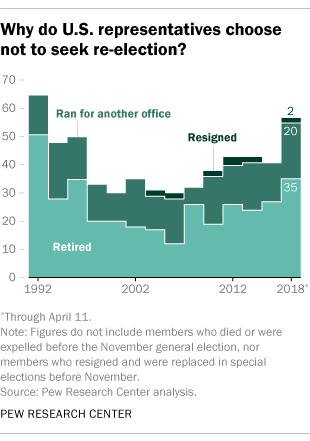 Of the 55 representatives who've chosen not to seek re-election to the Business firm this November, 20 are running for other offices instead – 11 for U.S. Senate and nine for governor of their land. (I representative, Maryland Democrat John Delaney, says he'll run for president in 2020, but that's a long way off so for now we're counting him as a straight retirement.) The 35 retirements so far this year are the most since 1996, when the same number of House members left without seeking some other office.
For this analysis, we combined several lists of parting House members (such as those from The Atlantic and the Firm Press Gallery) and verified the names through media reports; nosotros besides drew on data for past years that we gathered in 2014. Not included in the count were what might be chosen "involuntary departures" – where members died or (in one case) were expelled as well soon to fill their seats via special ballot before the November general. (Democrat Louise Slaughter of New York died in March; it's non clear whether there will be an early on special election for her seat.)
At the time of his resignation in Dec 2017, Conyers was the "dean of the Firm" – the member with the longest continuous service in that chamber. Conyers served 52.9 years in the Firm, making him the third-longest-serving representative in U.S. history. Other long-serving members hanging up their spurs this year include Sander Levin, D-Mich. (36 years in the Business firm), Joe Barton and Lamar Smith, both R-Texas (34 and 32 years, respectively), and Jimmy Duncan, R-Tenn. (30.2 years). All told, the 35 retiring members represent 588.6 years of House experience walking out the door (assuming they all complete their current terms).
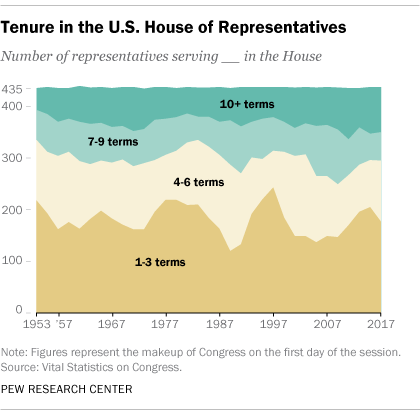 On average, the retiring members take 16.8 years of Firm experience (over again, assuming they all complete their terms), compared with 7.vi years for the members leaving to seek another role, and an average of 10.7 years for the members seeking re-election. Among all current members, the average tenure among Democrats is 12.7 years, versus 9.seven for Republicans; amid the retiring members, tenure averages 15.4 years for Democrats, 17.4 years for Republicans.
The spate of House members opting not to run for re-election this yr has prompted much commentary speculating on what it might or might not hateful for Democrats' hopes of regaining control of the bedroom. Simply large numbers of retirements don't necessarily portend large changes in the House's partisan makeup, based on a review of ballot results since 1992.
Over that timespan, there accept been iii elections that saw plenty seats switch parties to shift control of the Business firm. In 1994, a net 52 House seats swung from Autonomous to Republican as the GOP took control for the first time in more than four decades. Democrats regained control in 2006, when they picked up 30 Republican seats, only to lose it once more in 2010 when a cyberspace 63 seats turned from blueish to blood-red.
None of those elections were marked past peculiarly big numbers of voluntary departures. In 1994, 48 representatives chose to leave the House by retiring, resigning (without replacement) or running for some other function – not many more than than the 1992-2018 average of 41. Only 30 representatives passed on re-election bids in 2006 (less than 7% of the Firm), and 38 did so in 2010. On the other hand, while 1992 remains the record yr for voluntary departures, the GOP gained merely a cyberspace ten seats from Democrats in that yr'due south elections.
And picking off seats opened up past retirements, resignations or seeking other offices has not been a major factor behind the most recent shifts in House command. In 2010, merely 13 of the 66 Democratic seats that flipped to the GOP were open; only 7 of the 30 Republican seats that Democrats captured in 2006 to retake the House were open. In 1994, Republicans won 21 open Democratic seats, but it was the 35 Democratic incumbents they vanquish that gave them the bulk.
Note: This is an update to a post originally published on March 1, 2018.
Source: https://www.pewresearch.org/fact-tank/2018/04/11/near-record-number-of-house-members-not-seeking-re-election-in-2018/
0 Response to "Do Members of Congress Have to Be Elected Again"
Post a Comment